
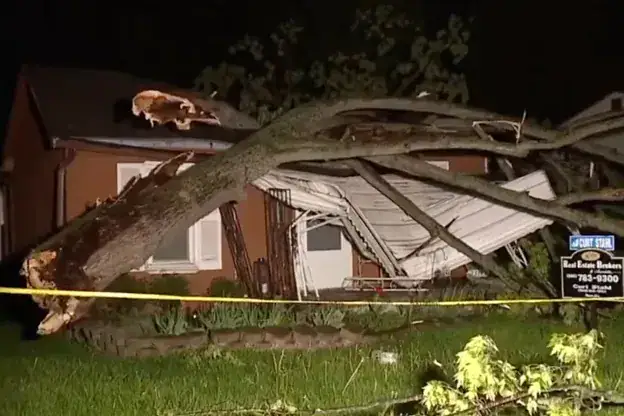
You heard the crack at 2 a.m. Maybe it was that June straight-line wind that ripped through Oakland County, or a February ice load that finally won. Either way, a tree fell on your property, and you need to know what to do before the sun comes up.
Stay calm. Get everyone away from the tree. Don’t touch anything near power lines. Then grab your phone, take photos of everything, call your insurance company, and get a 24/7 emergency tree response team on the line.
Seasonal Property Maintenance has been handling exactly these calls across Southeast Michigan for over 14 years. So we know the difference between a tree that snapped clean from the wind and one that tipped because three straight days of rain turned the root zone into soup, and that difference decides how the crew rigs the removal.
Here’s the full breakdown, step by step.
Step 1: Get Everyone Safe First
This is the only step that matters until it’s done.
We’ve pulled up to storm jobs in Clarkston, where the homeowner was standing under a half-split maple trying to figure out the damage. That tree hadn’t finished falling yet. The other half was hanging by a strip of bark, and one gust would’ve brought it right down on him.
If a tree fell on your house, get out of that section of the home. Walls shift. Rafters sag. Broken glass shows up in places you wouldn’t expect. Keep your kids in a safe room and your dogs on a leash, because animals will walk right toward the noise.
You’re probably thinking, can I at least go look at it?
From a distance, sure. But don’t walk under it. Don’t climb on the roof to check damage from above. And if you see any wires near that tree, stop where you are. According to Ready.gov, storm-damaged areas should be treated as hazardous until a professional confirms they’re safe. If anyone’s hurt, call 911 before anything else on this list.
Step 2: Stay Away from Downed Power Lines
Downed lines kill people every year in Michigan. This isn’t just the scary part of dealing with storm damage and a tree on your property. It’s the deadly part.
Here’s what most people don’t know. A downed power line can charge the ground up to 35 feet away from where it touches down, according to the Electrical Safety Foundation International. You can’t see that. You can’t hear it either. Even worse, the line doesn’t have to be sparking to be live.
Call these numbers right away:
- DTE Energy: 800-477-4747
- Consumers Energy: 800-477-5050
- 911 if anyone is close to a downed line
Don’t try to move branches touching a wire. Wet wood conducts electricity. We’ve seen guys grab a limb they figured was safe because it was “just wood,” and that’s how people end up in the hospital. Stay back. Keep your neighbors back. The utility crew will handle it.
Step 3: Document the Storm Damage Tree on Your Property
Don’t touch a single branch yet. Grab your phone first.
If a tree fell on your property, your insurance adjuster is going to want to see exactly what everything looked like before cleanup started. We’ve watched homeowners lose thousands in claim money because they cleaned up first and documented later. Don’t make that mistake.
Walk the whole scene. Photograph the fallen tree from at least four angles. Get close-ups of every dent, crack, hole, and scrape on your roof, siding, windows, fence, shed, driveway, whatever it hit. If the tree ripped out of the ground, shoot the root ball. That tells the adjuster whether the failure came from root rot, saturated soil, or pure wind force.
Now take a video. Walk the property and narrate what you see out loud. Something like, “This is the north side, the trunk punched through the soffit and there’s insulation hanging out.” That kind of detail moves your claim faster than a stack of blurry photos.
Most Michigan homeowners’ policies cover tree removal when a covered peril causes the fall. Wind, lightning, ice storms, those all qualify. The Insurance Information Institute confirms that your policy typically covers both the structural repair and the cost of removing the tree itself.
Step 4: Call Your Insurance Company
Got your photos? Good. Pick up the phone now.
Here’s why timing matters. If that tree is sitting on a cracked roof and it rains tonight, the water damage is secondary damage. Some insurers get picky about covering secondary damage if you waited too long to report the initial hit. Get a claim number before you authorize any removal work. That number protects you.
Homeowners insurance typically covers removal costs of $500 to $1,000 per tree when the fallen tree damaged a structure, according to the III. Your policy may also cover temporary housing if the house isn’t safe to sleep in.
Now, here’s where it gets tricky. If a healthy tree fell but didn’t hit anything, your policy probably won’t pay for removal. That surprises a lot of people. A fallen tree on your house in Michigan is typically an insurance claim. A fallen tree on your lawn? That’s usually your bill. Policies vary, so check yours before you assume anything.
Step 5: Call a Licensed Service for Emergency Tree Removal
You’ve handled safety, photos, and insurance. Time for a crew.
Not just any crew. After big storms, unlicensed guys with a pickup truck and a chainsaw start knocking on doors offering storm damage deals. Our crew here at Seasonal Property Maintenance has cleaned up after those operations more times than we can count. Broken fence posts, gouged siding, stumps left four inches above grade. One job in Waterford, the previous “crew” dropped a trunk section through the homeowner’s deck because they didn’t have the rigging to control the fall.
Look for a company with 24/7 availability, actual proof of insurance (ask for the certificate), and real experience with storm damage work. If the tree is on your house, ask whether they run crane-assisted removal for large trees. A 60-foot oak resting on a ridge beam isn’t a climb-and-cut job.
When you call, have your address, a rough estimate of the tree’s size, whether it’s on the house or near power lines, and your claim number ready. That saves time. The crew shows up with the right equipment instead of making a second trip.
For professional tree removal after a storm, pick a company with a real track record across Southeast Michigan. And not someone who rolled into town yesterday with a trailer.
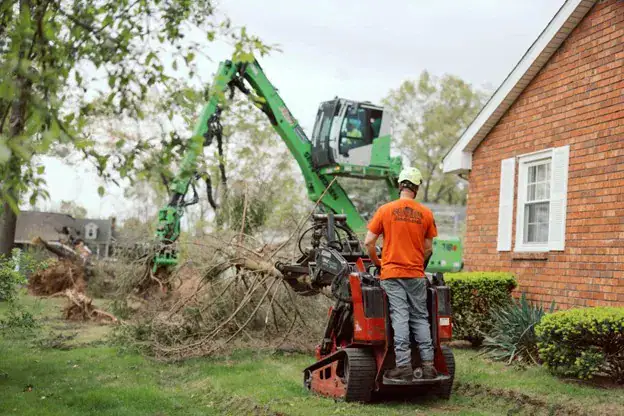
What Not to Do After a Tree Falls on Your Property
Knowing the right emergency tree removal steps matters. But knowing what not to do might save your life. We’ve seen every one of these mistakes play out in person.
- Don’t grab a chainsaw. The CDC reports roughly 36,000 chainsaw injuries a year. A storm-damaged tree has tension stored in places you can’t see. One bad cut and a limb kicks back at your chest.
- Don’t yank debris off a damaged roof. That mess of branches might actually be keeping rain out of your attic right now. Pull it wrong, and you collapse a weakened section.
- Don’t drive over the root ball area. The ground around an uprooted tree is soft and hollow underneath. Vehicles sink, or worse, the shifting destabilizes what’s left of the stump.
- Watch out for storm chasers. Unlicensed crews going door-to-door with “storm specials” are a red flag. They take cash, do sloppy work, and vanish before you realize the job’s half-done.
CAUTION: A fallen tree on a house in Michigan is NOT a weekend project. Not even close.
Frequently Asked Questions About What to Do When a Tree Falls on Your Property
Does homeowners' insurance cover a fallen tree on my house in Michigan?
Typically, yes. If wind, lightning, or ice brought the tree down and it hit your house, your homeowners’ policy usually covers both the repair and the removal. If the tree fell but didn’t damage any structure, removal is probably on you. The Insurance Information Institute says most policies cover $500 to $1,000 per tree for removal. But every policy reads a little differently, so call your agent and ask.
How long does emergency tree removal take?
Depends on the tree. A mid-sized maple on a garage might take 3 or 4 hours. A 70-foot oak through a roof with power lines involved could run 6 to 8 hours, sometimes longer. After a big storm, every tree service in the county is slammed, so response times stretch. Call early. The sooner you’re in the queue, the sooner a crew gets to you.
Can I remove a fallen tree from my property myself?
Small stuff on the ground, like branches you can pick up by hand? Go for it. But anything resting on your roof, leaning on a wall, tangled in wires, or thick enough to need a chainsaw? That’s a professional job. According to OSHA, fallen trees and downed lines are among the top causes of storm-related injuries. Saving a few hundred bucks isn’t worth a trip to the ER.
Disclaimer: This content is for informational purposes only. Tree work is dangerous. Always talk to a licensed, insured professional before attempting any tree removal, trimming, or land clearing. Seasonal Property Maintenance is fully licensed and insured to perform tree services throughout Southeast Michigan.
Need Help Right Now?
If a tree fell on your property in Michigan and you need someone there fast, we’ve got the crew, the cranes, and 14-plus years of storm damage experience to handle it. We pick up the phone 24/7 because trees don’t wait for business hours.
Call 248-875-4942 right now, or get emergency help now to send us the details.